
This is a guest post by Nelson Chu from SuperInsight, a partner of LM Summary Services.
Social Security Disability firms have gotten very good at intake. Between lead generation platforms, qualified call centers, retainer automation, and the CRM systems tying it all together, the front end of most practices runs at a level of sophistication that would have been unrecognizable a decade ago. Marketing spend is tracked down to the cost per signed retainer, and new claimants are coming in faster than ever.
What happens immediately after that signature, though, is where many firms lose the advantage they just paid to create.
In most SSD practices, the period between a signed retainer and the first substantive action on a case is longer than anyone would like to admit. Medical record requests go out late, sometimes days or weeks after intake, because there is no defined trigger in the handoff between intake and case development. The file gets created, assigned to an attorney or paralegal, and then sits while that person finishes the work already on their desk. Records arrive in batches over the following weeks, but nobody reviews them until a deadline forces the issue. By that point, the attorney is reading through hundreds of pages under time pressure, looking for evidence they should have identified much earlier.
Meanwhile, the claimant hears nothing. They signed a retainer, gave the firm access to their medical history, and then entered what feels like a black hole. Their calls go to voicemail or get fielded by an intake coordinator who has no visibility into case status. For someone dealing with a serious medical condition and real financial hardship, that silence carries weight. It erodes trust in a way that is difficult to rebuild, and it often leads to negative reviews, missed referrals, or clients seeking other counsel entirely.
These are not isolated incidents. They are patterns, and they are almost always structural. The intake side of the operation has clear ownership and measurable timelines. The post-intake side frequently does not. Cases drift into an operational gap between departments where no single person is accountable for driving progress. The firm excels at bringing clients in but struggles to move their cases forward at the pace those clients expect.
The growth implications compound quietly. Many SSD firms reach a stage where they invest more aggressively in marketing, expecting that additional volume will produce proportional revenue. When the post-intake process cannot absorb that volume, the existing inefficiencies multiply. Attorneys become overextended, record requests fall further behind, and communication with claimants degrades in ways that are hard to see from the inside. The firm spends more to acquire each client while simultaneously delivering a worse experience. This can persist for months before the root cause becomes visible, because the symptoms, whether missed deadlines or staff burnout or a cluster of negative Google reviews, look like separate problems rather than pieces of a single operational failure.
Addressing this starts with collapsing the gap between intake and first action. In practical terms, that means medical records should be requested within 24 hours of a signed retainer, as a firm-wide standard rather than an aspiration. It means assigning a specific individual, whether a case manager or a senior paralegal, to own every new case through the post-intake phase. And it means establishing a defined checkpoint within the first five to seven business days where someone with legal training has reviewed at least the initial records and produced a working summary of conditions, treatment history, and any red flags worth investigating.
That last point deserves particular emphasis, because medical record review is the single largest bottleneck in SSD case development at most firms. Records may arrive within a reasonable timeframe, but they sit in a queue waiting for attention because the people responsible for reviewing them are occupied with cases further along in the pipeline. By the time someone reads through the documentation, weeks have passed, and the firm has lost its window to identify problems early. Maybe there is a gap in treatment that needs to be addressed before hearing. Maybe the records contain evidence that maps to a specific residual functional capacity argument. Maybe the claimant qualifies under a Blue Book listing that nobody has checked yet. All of that gets discovered late, if it gets discovered at all.
This is also where the distinction between collecting records and understanding records becomes critical. Receiving a file from SSA or a provider is a logistical step. Turning that file into organized chronologies, flagged RFC-relevant findings, identified treatment gaps, and pattern recognition across providers is the analytical step that actually drives case outcomes. Many firms treat these as the same activity, when in reality they require very different processes and, increasingly, very different tools.
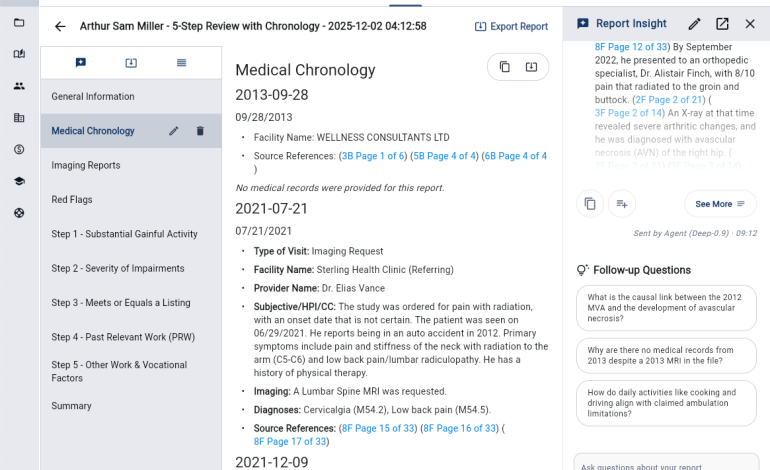
AI-powered medical record review has begun to change the calculus here. Platforms like SuperInsight can process a full set of medical records, regardless of page count or format, and produce a structured first-draft analysis in roughly an hour. The output includes medical chronologies organized by time and body system, RFC-aligned evidence mapping that covers exertional, postural, and environmental limitations, Blue Book listing criteria matching, and precise section-and-page citations hyperlinked back to the source documents. Attorneys can review reports side by side with the original records, verify every finding against the source, and refine the analysis using natural language commands. For firms that also use ERE monitoring tools like Chronicle to track incoming records, SuperInsight integrates directly, so exhibits can be imported without manual uploads, cutting out a layer of administrative delay that adds up quickly at volume.
The practical effect is that an attorney receiving a new SSD file no longer starts with a stack of unorganized pages. They start with a structured summary that tells them which conditions are documented, where the strongest evidence sits, what gaps exist, and which findings matter most for the RFC assessment at issue. That changes the entire cadence of post-intake case development. It also means the firm can call the claimant within days of signing and communicate specifics: their records have been reviewed, certain conditions and treatment patterns have been identified, and the next steps are already underway.
For claimants, that kind of early, specific communication matters more than most firm owners realize. Disability applicants are not evaluating their attorney on the basis of motion practice or evidentiary strategy. They are evaluating based on whether they feel informed and whether they believe their case is actually moving. A firm that demonstrates progress within the first week of representation earns a level of confidence that no volume of paid advertising can replicate. That confidence shows up later as cooperation when the firm needs information, as positive reviews on Google and Avvo, and as referrals to family members and friends going through similar situations.
For firm owners and operations managers looking at where to begin, the most productive first step is a candid measurement. Pull the last twenty or thirty cases and calculate the elapsed time between intake completion and the first substantive record review. If the average is more than two weeks, that number alone identifies where the opportunity lies. From there, assign explicit post-intake ownership so that new cases do not drift unmonitored between departments. Review whether internal timelines match what the firm’s marketing promises. A website that emphasizes aggressive advocacy loses credibility when a new client waits three weeks without a single update.
And before trying to scale volume, address the record review bottleneck. Whether that means restructuring internal workflows or adopting AI-powered review tools purpose-built for disability cases, the objective is the same: ensure that every new case receives timely, substantive attention from the moment the retainer is signed.
Sustained growth in an SSD practice is ultimately an operations problem. The firms that will scale successfully over the coming years are the ones recognizing that intake is only the entry point of the client relationship, and that the infrastructure supporting what comes next, from record review through hearing preparation, is what determines whether the firm can grow without the quality of its work declining in the process.
Tools like SuperInsight are part of that infrastructure. They do not replace attorney judgment. What they do is ensure that judgment gets applied earlier, with better information, and at a pace that matches the expectations the firm has already set with the clients walking through the door.